
.png)
Ada Lovelace and the courage to imagine
- Ian Baynham
- Mar 10
- 6 min read
Updated: Mar 12
History has a habit of misreading women before it understands them.
Long before their contributions are recognised, many are dismissed as excessive in some way; too ambitious, too emotional, too unconventional, too much. This theme sits at the heart of the Unlabelled & Limitless Formerly “Too Much” series, which explores women whose ideas, influence, or behaviour challenged the expectations of their time.
Few examples illustrate this pattern more clearly than Ada Lovelace.
Writing in the early nineteenth century, decades before electronic computers existed, Lovelace was already thinking about machines not just as calculators, but as systems capable of manipulating symbols, patterns, and ideas. In doing so, she outlined conceptual foundations that would not be fully realised for more than a century.
In the blog article that follows, Ian explores how Lovelace’s unique blend of imagination and mathematical thinking, what she famously called “poetical science”, allowed her to see possibilities that many of her contemporaries could not yet imagine.
Imagining Computing Before Computers
When people talk about the history of computing, the image that usually comes to mind is machines.
Large room-sized machines. The twentieth-century machines that finally made modern computing possible.
But long before those machines existed, before electronics, before punched cards were widely used, and before the word “computer” meant anything more than a person who performed calculations, someone had already begun imagining what such machines might eventually become.
Her name was Ada Lovelace.


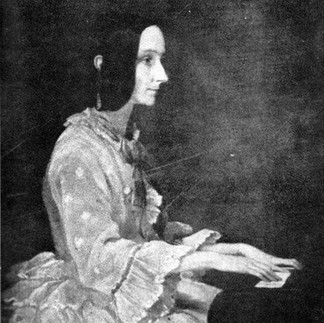


Image 1: Watercolour, Ada Lovelace, possibly by A E Chalon (1780-1860), [c1840]. 25 x 18.3 cm. Portrait, TQL to L. looking front, in evening dress with mantilla, holding fan. Portrait of Ada, Countess of Lovelace. Science Museum Group. © The Board of Trustees of the Science Museum. Image 2: Painting of Ada Lovelace at a piano in 1852 by Henry Phillips. While she was in great pain at the time, she sat for the painting as Phillips' father, Thomas Phillips, had painted Ada's father, Lord Byron. By Henry Phillips (1820–1868), son of Thomas Phillips, tratto dalla fotografia di Antoine Claudet - Scanned from The Calculating Passion of Ada Byron by Joan Baum., Public Domain, https://commons.wikimedia.org/w/index.php?curid=19076901 Image 3: Lord Byron, a coloured engraving. By Unknown author, coloured by uploader - www.noelcollection.org, Public Domain, https://commons.wikimedia.org/w/index.php?curid=373347
A Childhood Shaped by Logic
Born in London in 1815, Augusta Ada King, Countess of Lovelace, entered the world in circumstances that were already unusual. She was the daughter of the poet Lord Byron, one of the most famous and controversial figures of his time, and Annabella Milbanke, a mathematically gifted woman whom Byron once nicknamed the “Princess of Parallelograms.”
Ada never knew her father. Byron left England shortly after her birth and died when she was eight. Her mother, determined that Ada would not inherit what she considered Byron’s dangerous poetic temperament, placed a strong emphasis on mathematics, logic, and scientific study throughout her education.
In an era when most women were denied formal education in science, Ada was tutored in mathematics by some of the most respected thinkers of the day. Among them was the mathematician Augustus De Morgan, one of the founders of modern mathematical logic.
Yet what made Ada Lovelace remarkable was not simply that she studied mathematics, but the way she thought about it.
Poetical Science
She described her own approach as “poetical science,” a phrase that captures something important about her mind. Where others saw mathematics as rigid and mechanical, Ada saw patterns, relationships, and possibilities. She moved easily between analytical precision and imaginative speculation, connecting ideas that most people kept firmly separated.
This ability became particularly important when she was introduced to Charles Babbage.
Babbage was a mathematician and inventor who had designed a machine called the Analytical Engine. Unlike earlier calculating devices, the Analytical Engine was intended to perform a wide range of operations automatically. It included many concepts that would later become fundamental to computers, including memory, conditional operations, and a form of programmable instructions using punched cards.
The Analytical Engine and The First Computer Program

But in the 1830s and 1840s, the Analytical Engine remained largely theoretical. The technology and engineering required to build it were beyond what could realistically be achieved at the time.
To most people who encountered Babbage’s designs, the machine appeared to be an extremely complicated calculator. Ada Lovelace saw something far more radical.
"Where others saw a complicated calculator, Ada Lovelace saw the conceptual foundations of a programmable machine".
In 1842, an Italian engineer named Luigi Menabrea wrote a technical paper describing Babbage’s Analytical Engine. Ada was asked to translate the paper from French into English. During the process, she began adding her own notes and commentary.
Those notes eventually grew to be three times longer than the original article. Within them, Ada did something extraordinary.
She outlined a step-by-step set of instructions that would allow the Analytical Engine to calculate a sequence of Bernoulli numbers. In modern terms, this sequence of instructions is recognised as the first published computer program.
Seeing Beyond Numbers
But the program itself was only part of her contribution.
What makes Ada Lovelace’s work so remarkable is the way she thought about what such a machine could ultimately do.
Many of her contemporaries believed that calculating machines could only manipulate numbers in strictly mathematical ways. Ada challenged that assumption. She pointed out that numbers could represent more than quantities.
Numbers could represent musical notes, it could represent symbols and it could also represent patterns. If that were true, then a machine capable of manipulating numbers could potentially manipulate anything that could be encoded symbolically. Music, she suggested, might one day be composed by such a machine.
It was an astonishing idea for the 1840s.
Ada Lovelace had effectively described the conceptual foundations of general-purpose computing more than a century before the first electronic computers appeared.
Her insight was not about the machinery itself, and more about the nature of information. That distinction, subtle as it may seem, lies at the heart of modern computing.
The ability to recognise patterns, abstractions, and connections across seemingly unrelated domains is often described today as systems thinking. Ada Lovelace displayed it in abundance. She was able to step back from the mechanics of the Analytical Engine and see the broader implications of what programmable machines might one day become.
Yet during her lifetime, her work did not receive widespread recognition.
Partly this was because the Analytical Engine itself was never completed. Without a functioning machine, her ideas remained largely theoretical. But social expectations also played a role. Victorian society had little framework for recognising women as contributors to scientific or technological progress.
Her intellectual intensity was sometimes described as excessive. Her fascination with machines and mathematics was seen as unusual. Even admirers occasionally portrayed her more as an eccentric curiosity than a serious thinker.
It would take more than a century for the full significance of her work to be widely appreciated.
A Vision Ahead of Its Time
When historians of computing began re-examining the origins of programming in the twentieth century, Ada Lovelace’s notes stood out immediately. Not only had she written what could be considered the first computer program, she had also articulated the broader philosophical implications of programmable machines.

She understood that the real power of computing would lie not in calculation alone, but in the manipulation of symbols and ideas.
Today, Ada Lovelace is widely recognised as a pioneer of computer science. Her name is attached to programming languages, research institutes, and an international celebration of women in technology.
Yet her legacy is about more than a single technical achievement.
It lies in the way she approached knowledge itself.
Ada Lovelace believed that mathematics and imagination were not opposites. She saw them as complementary ways of understanding the world. Her “poetical science” blended creativity with analytical thinking, allowing her to see possibilities that were invisible to many of her contemporaries.
The qualities that made her unusual in Victorian society were the very qualities that allowed her to think beyond the limitations of her time.
And long before the first computer ever flickered to life, she had already begun imagining what such machines might eventually make possible.
Ian Baynham


A really interesting and detailed read. Lovely to celebrate her contribution to technology.